I was recently blessed and overjoyed to be invited to paint a mural in downtown St Louis for the Delmar Loop Mural Festival (summer 2025). I got the call out of the blue from the curator, a lovely human with whom I discovered so many shared experiences as we got to know each other.
This is the reason I love mural painting—it’s a magical life full of surrender and trust and serendipity. I never know when or where or how my next project will come into being, and once a project does become manifest, I usually find layered connections and webs of meaning so intricate I could have never planned it better.
A Project That Pushed Me
The mural in St Louis was beautiful in just this way—besides forming a deep connection with the project curator, I got to spend time with a very dear friend from my early 20s who now lives in St Louis, introduce her to my assistant from Chicago, and we all connected so well as a group that we are planning an international trip together.
But was the mural that easy and serendipitous to paint?
A hard no!! This project, more than any other recent project, made me question everything about my process. I’m ready and honest enough with myself to consider that maybe I’ve been doing everything in the hardest way possible—and maybe it’s time to change everything.
Every single thing—from how I sketch the design on the wall, to the type of paint I use, to even my style and the technique of my brushstrokes. If anything, the journey of healing myself physically and emotionally during these last 3 years has humbled me and made me open and curious to re-evaluate every habit in my life.
During this project, I realized that the way in which I work comes from a dis-regulated nervous system, and I’m ready to change it!
Painting the Tivoli
The mural project in St Louis was on the façade of a beautiful historic brick building called the Tivoli. It used to be a movie theater showing cult classics, and now it is a church that pulls its congregation from across St Louis.
I never saw a more diverse congregation and people so happy and proud of their church. It was a wonderful energy to be a part of, from the pastor and his beautiful family who lived around the corner from the church and came to check every day on my progress, to the parishioners who celebrated each emerging flower and color on the wall.
The mural was big though, wayyyy bigger than I could tell from the photos of the building I received before I got to St Louis.
Right next to the building was another mural by famed local artist Cbabi, celebrating Maya Angelou and her work “I Know Why the Caged Bird Sings.”
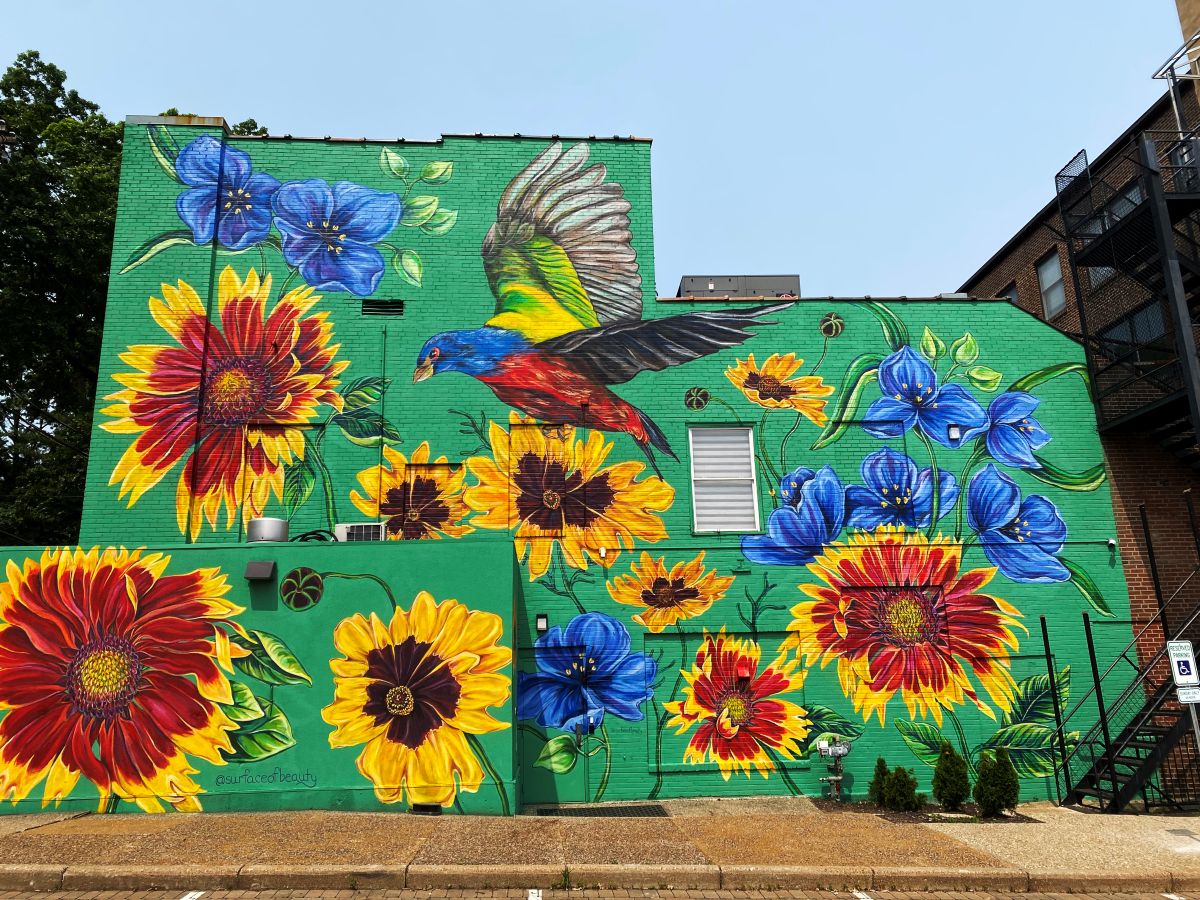
I had the idea that on my mural, I would feature a magnificent bird flying free among the native wildflowers of Missouri, to bring that hope and prayer into reality. That meant that I would have to draw a bird that was two stories tall from beak to wing-tip.
And of course, because I’m Surface of Beauty, I do everything freehand! Uh-oh.
Freehand Meets Its Challenge
It’s long been a point of pride for me that my murals are drawn entirely free-hand, and it is a sort of beautiful dance and communication between me and the wall. Most other mural artists use some sort of grid/projection/AI glasses to get the initial sketch up on the wall, but I love the first day exploration of feeling out the wall in its physicality and imperfections, adjusting the design to grow around the odd AC vent or exhaust pipe, and making my flowers really grow into the wall rather than just decorate it.
I’ve felt that this freehand technique is my hidden secret, which makes my murals come alive, grow onto the wall, and really become a part of their environment.
But on this project, I realized that everything has a time and a place. I was woefully unprepared to draw a two-story bird. As I was trying to trace out the spread top wing, I couldn’t even SEE, let alone imagine, the part of the wall where the beak should be. It was one full story below me.
How could I get any sense of the scale or the proportions of the body?
I was shaking and sweating, and almost crying. Nothing to do but just keep going up and down on the lift.
Down I went—oh no! The bird should be two times bigger at least! Back up—is the beak here? Back down—Oh no, it should be at least two yards to the left.
Well, that was the first part of the afternoon. I will say that when I nailed it, and yes, I finally did nail it, to where it just clicked into place and was absolutely perfect, it was a feeling like no other. I stood on the ground looking up at the bird, and I had no changes, no comments. I felt a harmony in my body and the wall as if we were one, and it was truly bliss. And I love those moments more than anything else in life.


But at what cost?
The next day I was tired, and I worked slower, and I had less internal energy to make miracles happen. I slogged through a blur of petals and was grumpy with my assistant. And that’s when I realized that it’s not fair to my animal body or to anyone else around me to live perpetually on that wing-it, make a miracle high.
This is my job, my work, and the kind, responsible thing to do is make a plan and follow it. Even if that means using a grid to get the design up (for really big murals only, of course).
For the next 7 days, between runs to Lowe’s to get the super durable house paint that I use for all my murals, I re-examined my entire mural process with my assistant. Her perspective was invaluable. Together we decided that those miracle moments, doing the impossible and having everything click into place after hours of sweating and panicking, are indeed what makes my work come alive and have its unique power.
But those moments can be optional, for when I have the energy, time, and internal resources to make them happen. I can include a few of those moments each mural, on a particularly wildly unfurling flower, or a beautiful swirl of tiny buds.
In short, they are a luxury. But it is unfair to myself to expect every single thing I paint to come from that space. I need to have an automated system that I can fall back on for most of the days, and that other people can more easily help me with. That will involve grids, more highly pigmented paints so I have less work to do with color layering and shading, and more initial planning and color mixing to make a more systemized approach to how I use the color contrasting I love so much in my work.
A Turning Point in My Career
I think this mural was one of the most important murals in my career, because it marked the gateway from an entirely new way of working. And I think the end result is going to be much better.
For example, in this mural, I painted all the leaves on the last day. I gave my life blood to the flowers, and by the time the moment for the leaves rolled around, I had nothing left to give. I really didn’t.
So between you and me, the leaves are a poor shadow of what I was hoping for. I think in my new system, I won’t waste so much energy in the initial days, and I’ll be able to get through the whole mural more easily and then make moments of magic happen in the end when I have the luxury to do so. I think it will lead to a more cohesive mural, with moments of true excellence layered on top of a base that’s already good enough.
And my nervous system won’t have to work as hard to keep up with my roller-coaster ride of panic and bliss hormones. I’m very excited to see what the new me will create.