I have recently started learning classical oil painting, something that I have been yearning to do for about 10 years now. It took me quite a long time to find a teacher who I wanted to learn from, as I find many oil painters paint in quite a dark style.
Though my mural work is very bright and colorful, what I want to learn from oil painting is more about luminosity and depth—a richness and saturation of color which glows from contrast and from the oil itself.
I grew up with the paintings of Dante Gabriel Rossetti in my local art museum, and the radiance of his colors has deeply influenced me consciously and subconsciously.
The Pre-Raphaelite period of art history, of which he was a founder, is perhaps the most under-rated period of artistic expression. The Pre-Raphaelites used imagery and metaphors from literature and even fairytales to create symbolic and almost magical works. But it is their deep use of color and light that inspires me the most.
Two Worlds of Paint, Two Ways of Thinking
Oil painting is about layers, but in a very different technique than the layers I use in my mural painting.
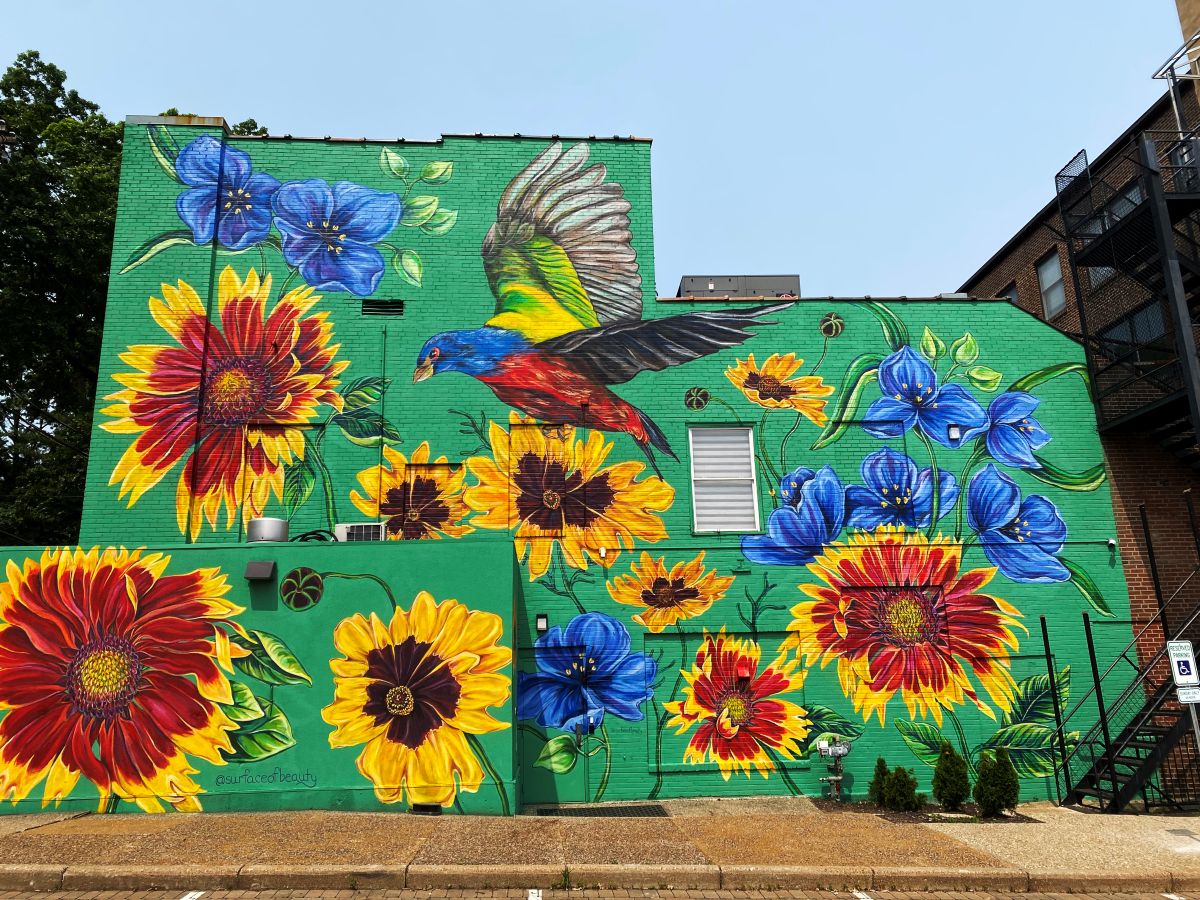
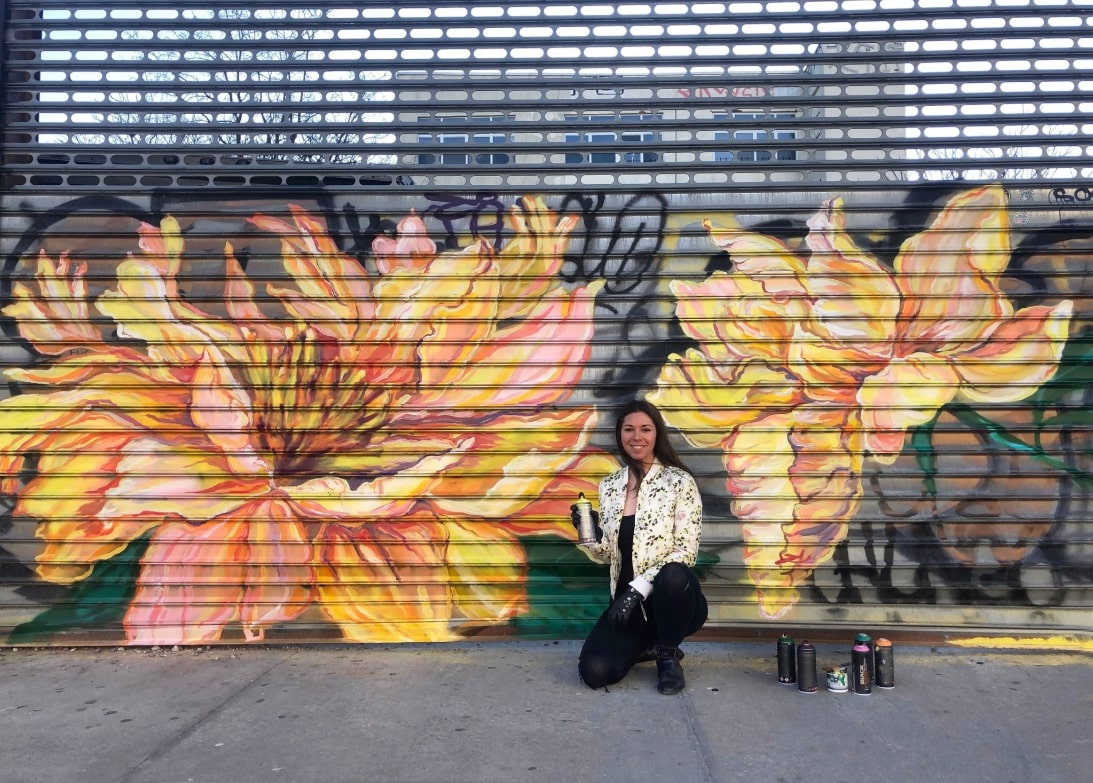
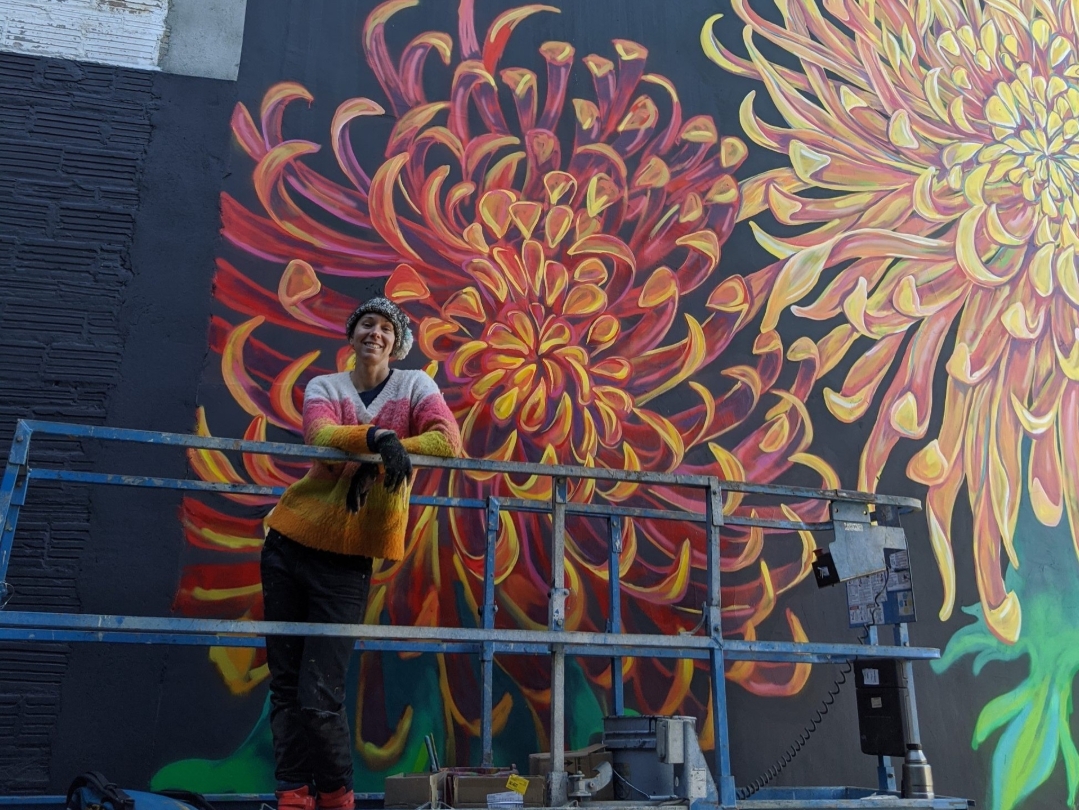
When I paint my flower murals, I am using house paint, which dries very quickly. One of my favorite techniques is to not clean my brush during the entire time I am painting a single flower, and the different colors layer into the bristles of my brush and spread out as I paint, creating a striped effect almost like the veins of a petal.
As you may imagine, this is a disaster in oil painting. Everything will become muddy as all the colors mix together to form shades of black and brown.
Layers in oil painting refer to a very different concept and technique—it’s about building the whole painting up in stages, starting with a dark and very thin background layer, and adding color, shadow, and light in progressively. It requires patience, and a delicacy which is quite foreign to me as someone who has learned to prioritize speed and efficiency in painting my multi-story flower murals.
When the Studio Entered the Wall
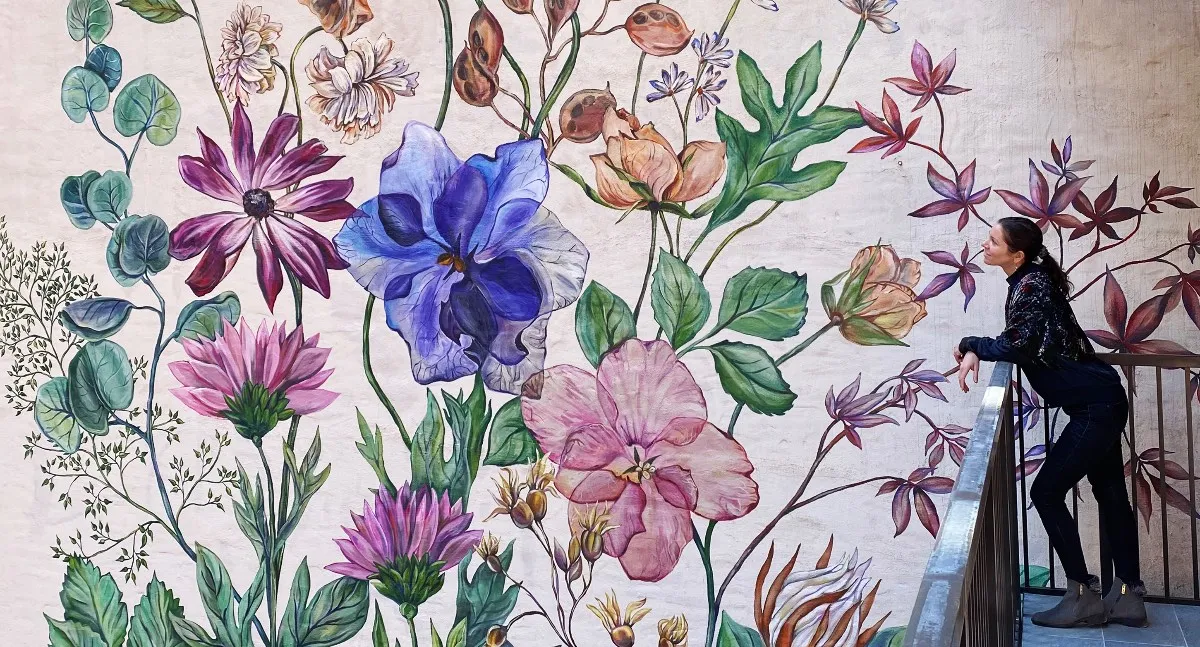
However, I really noticed the effects of my oil painting practice in my most recent mural. Last month, I painted one of my favorite murals of my career, for the courtyard of the luxury apartment building The Village West in Manhattan.
Many of my followers on Instagram, as well as my friends, commented that I showed growth as an artist, that I was using color more subtly, and most of all, that the flowers had a translucent effect.
The focal point of this mural was two pressed flowers—the type of dried flowers that you press in a book and flatten to preserve. I became fascinated by the overlapping of the various petals, and the color changes that occurred within them—sometimes two petals overlapping in one area, sometimes one petal completely overlapped on top of a second, larger one.
The ranges in color, for example from almost black, to almost transparent white, and all variations in between, fascinated me. While normally, I paint flowers blooming and opening, touched by light and shadow in a three-dimensional interaction, the flatness of this flower allowed me to focus more on the subtlety of color changes without dimensionality being involved.
This process reminded me so much of the thinness and restrained layering I have been studying in oil painting.
Of course, this mural had all of the challenges of large-scale painting that I have grown to love—and required the speed and efficiency which I have learned as a mural artist. I surprised myself by painting this entire 3 story mural in less than 7 days—and even better, I felt relaxed and calm throughout. Well, except for the first day, where my entire body was shaking uncontrollably due to the height of the scaffolding. Muscle memory is an amazing thing; by the second day, I felt completely at ease and couldn’t even understand why I had been so terrified just the day before.
Three Stories, One Unexpected Problem

The mural for The Village West was an unique experience in many aspects.
The day that I arrived to start work–with my scissor lift rental booked to start the next day–I learned from the construction supervisors that the floor of the courtyard area could not support the weight of a lift. Apparently, the floor was floating, with thin wooden planks supported on plastic pins, and nothing but empty space underneath. The machine could break through the floor and fall 2 feet down, tipping over in the process.
Hmmm.
I went home after about an hour on site, and proceeded to wait for 2 weeks while they constructed a three-story supported scaffolding with extensions, in order to reach the wall in a close enough distance to comfortably paint.
It was an unexpected delay, but I have learned that there is usually something unforeseen that I learn the first day I arrive onsite.

I have never painted using a multi-story scaffolding before, and it presented many new challenges.
The first was that I had to be harnessed in at times, with a very heavy metal harness that weighed on my back. Secondly, the structure of the scaffolding made it hard to see my mural in its entirety, or even the entire height of the wall, which I usually use to judge the scale of my flowers. As I hand-draw everything based on my visual perception alone, I had to make some adaptations and view the wall from balconies of second and third story apartments to understand what I was doing.
Also, I realized that the nature of the scaffolding and the planks at different levels gave me the temptation to paint almost in lines. I had the tendency to position each flower with the end touching the bottom of the plank, or the top touching the top of the plank above me. I realized this would create an effect of horizontal lines of empty space once the scaffolding was removed, even though I couldn’t see them as I was painting.
I began to consciously position flowers in the middle of the planks, even though this was much harder since I had to move all my paints between levels in order to complete them. Moving the twenty-plus paints I use in any given mural between levels represented a challenge in itself.
How do I move cans of paints between levels while I need to be harnessed in, and also need my hands to grab onto the railings while moving between planks? That was probably the hardest aspect of this scaffolding adventure.
The Moment the Scaffolding Came Down

The day the scaffolding came down, when I no longer had the opportunity to make any changes, is when I saw my mural in its entirety for the first time.
It literally stopped my heart, and I saw not even one change that I desired to make. Even the clients said they couldn’t imagine any changes and that it was absolutely perfect.
I think the slowness I have been learning in my studio oil painting, and the forced slowness that the scaffolding imposed on me, both greatly came to my aid in this mural. My colors were more subtle, my composition was thought through from multiple angles and views, and I spent a great deal of time thinking about layering the paint in a whole new way.
I am grateful and inspired to continue learning and working out of my comfort zone as an artist.