Layers Upon Layers: How Oil Painting Changed the Way I See My Murals

I have recently started learning classical oil painting, something that I have been yearning to do for about 10 years now.  It took me quite a long time to find a teacher who I wanted to learn from, as I find many oil painters paint in quite a dark style.

Though my mural work is very bright and colorful, what I want to learn from oil painting is more about luminosity and depth—a richness and saturation of color which glows from contrast and from the oil itself.

I grew up with the paintings of Dante Gabriel Rossetti in my local art museum, and the radiance of his colors has deeply influenced me consciously and subconsciously.

The Pre-Raphaelite period of art history, of which he was a founder, is perhaps the most under-rated period of artistic expression.  The Pre-Raphaelites used imagery and metaphors from literature and even fairytales to create symbolic and almost magical works. But it is their deep use of color and light that inspires me the most.  

Two Worlds of Paint, Two Ways of Thinking

Oil painting is about layers, but in a very different technique than the layers I use in my mural painting.

When I paint my flower murals, I am using house paint, which dries very quickly.  One of my favorite techniques is to not clean my brush during the entire time I am painting a single flower, and the different colors layer into the bristles of my brush and spread out as I paint, creating a striped effect almost like the veins of a petal.

As you may imagine, this is a disaster in oil painting.  Everything will become muddy as all the colors mix together to form shades of black and brown.

Layers in oil painting refer to a very different concept and technique—it’s about building the whole painting up in stages, starting with a dark and very thin background layer, and adding color, shadow, and light in progressively.  It requires patience, and a delicacy which is quite foreign to me as someone who has learned to prioritize speed and efficiency in painting my multi-story flower murals.

When the Studio Entered the Wall

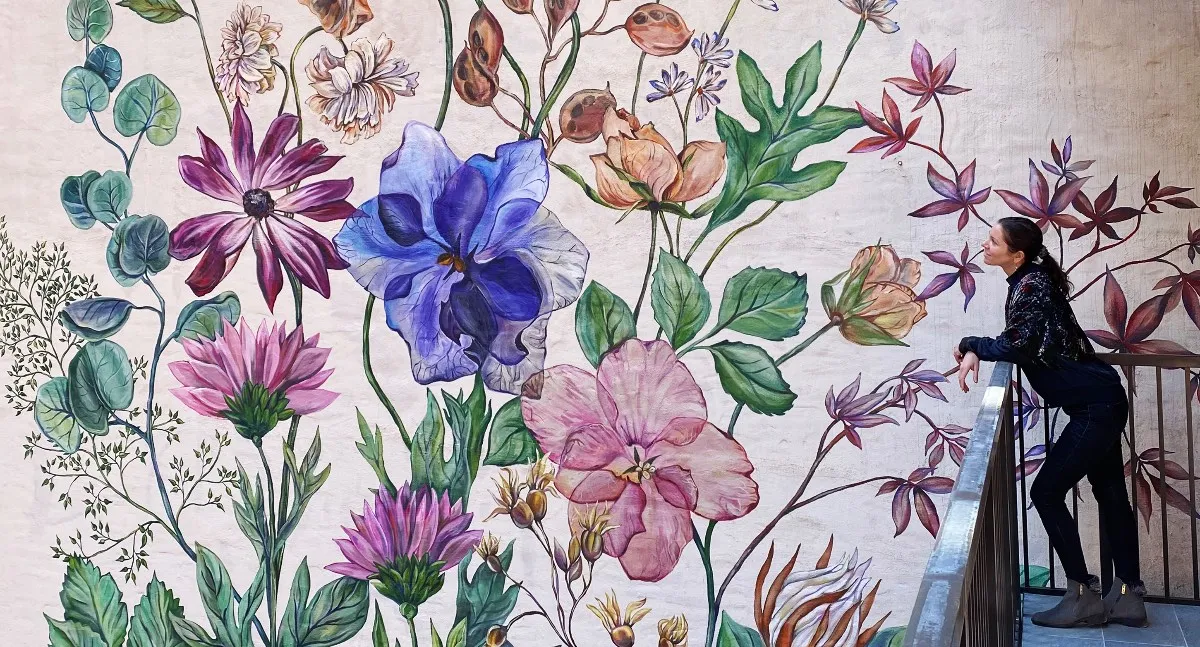
However, I really noticed the effects of my oil painting practice in my most recent mural.  Last month, I painted one of my favorite murals of my career, for the courtyard of the luxury apartment building The Village West in Manhattan.

Many of my followers on Instagram, as well as my friends, commented that I showed growth as an artist, that I was using color more subtly, and most of all, that the flowers had a translucent effect.

The focal point of this mural was two pressed flowers—the type of dried flowers that you press in a book and flatten to preserve.  I became fascinated by the overlapping of the various petals, and the color changes that occurred within them—sometimes two petals overlapping in one area, sometimes one petal completely overlapped on top of a second, larger one.

The ranges in color, for example from almost black, to almost transparent white, and all variations in between, fascinated me.  While normally, I paint flowers blooming and opening, touched by light and shadow in a three-dimensional interaction, the flatness of this flower allowed me to focus more on the subtlety of color changes without dimensionality being involved.

This process reminded me so much of the thinness and restrained layering I have been studying in oil painting.

Of course, this mural had all of the challenges of large-scale painting that I have grown to love—and required the speed and efficiency which I have learned as a mural artist.  I surprised myself by painting this entire 3 story mural in less than 7 days—and even better, I felt relaxed and calm throughout.  Well, except for the first day, where my entire body was shaking uncontrollably due to the height of the scaffolding.  Muscle memory is an amazing thing; by the second day, I felt completely at ease and couldn’t even understand why I had been so terrified just the day before.

Three Stories, One Unexpected Problem

Three Stories, One Unexpected Problem

The mural for The Village West was an unique experience in many aspects.

The day that I arrived to start work–with my scissor lift rental booked to start the next day–I learned from the construction supervisors that the floor of the courtyard area could not support the weight of a lift.  Apparently, the floor was floating, with thin wooden planks supported on plastic pins, and nothing but empty space underneath.  The machine could break through the floor and fall 2 feet down, tipping over in the process.

Hmmm.  

I went home after about an hour on site, and proceeded to wait for 2 weeks while they constructed a three-story supported scaffolding with extensions, in order to reach the wall in a close enough distance to comfortably paint.

It was an unexpected delay, but I have learned that there is usually something unforeseen that I learn the first day I arrive onsite.

Painting Floral mural

I have never painted using a multi-story scaffolding before, and it presented many new challenges.

The first was that I had to be harnessed in at times, with a very heavy metal harness that weighed on my back.  Secondly, the structure of the scaffolding made it hard to see my mural in its entirety, or even the entire height of the wall, which I usually use to judge the scale of my flowers.  As I hand-draw everything based on my visual perception alone, I had to make some adaptations and view the wall from balconies of second and third story apartments to understand what I was doing.

Also, I realized that the nature of the scaffolding and the planks at different levels gave me the temptation to paint almost in lines. I had the tendency to position each flower with the end touching the bottom of the plank, or the top touching the top of the plank above me.  I realized this would create an effect of horizontal lines of empty space once the scaffolding was removed, even though I couldn’t see them as I was painting.

I began to consciously position flowers in the middle of the planks, even though this was much harder since I had to move all my paints between levels in order to complete them.  Moving the twenty-plus paints I use in any given mural between levels represented a challenge in itself.

How do I move cans of paints between levels while I need to be harnessed in, and also need my hands to grab onto the railings while moving between planks?  That was probably the hardest aspect of this scaffolding adventure.

The Moment the Scaffolding Came Down

Completed 3 stories Flower Mural

The day the scaffolding came down, when I no longer had the opportunity to make any changes, is when I saw my mural in its entirety for the first time.

It literally stopped my heart, and I saw not even one change that I desired to make.  Even the clients said they couldn’t imagine any changes and that it was absolutely perfect.

I think the slowness I have been learning in my studio oil painting, and the forced slowness that the scaffolding imposed on me, both greatly came to my aid in this mural.  My colors were more subtle, my composition was thought through from multiple angles and views, and I spent a great deal of time thinking about layering the paint in a whole new way.

I am grateful and inspired to continue learning and working out of my comfort zone as an artist.
How Mural Painting Can Be Exhilarating and Too Much At the Same Time: Tuning into my Nervous System and Re-evaluating my Work Process

I was recently blessed and overjoyed to be invited to paint a mural in downtown St Louis for the Delmar Loop Mural Festival (summer 2025). I got the call out of the blue from the curator, a lovely human with whom I discovered so many shared experiences as we got to know each other.

This is the reason I love mural painting—it’s a magical life full of surrender and trust and serendipity. I never know when or where or how my next project will come into being, and once a project does become manifest, I usually find layered connections and webs of meaning so intricate I could have never planned it better.

A Project That Pushed Me

The mural in St Louis was beautiful in just this way—besides forming a deep connection with the project curator, I got to spend time with a very dear friend from my early 20s who now lives in St Louis, introduce her to my assistant from Chicago, and we all connected so well as a group that we are planning an international trip together.

But was the mural that easy and serendipitous to paint?

A hard no!! This project, more than any other recent project, made me question everything about my process. I’m ready and honest enough with myself to consider that maybe I’ve been doing everything in the hardest way possible—and maybe it’s time to change everything.

Every single thing—from how I sketch the design on the wall, to the type of paint I use, to even my style and the technique of my brushstrokes. If anything, the journey of healing myself physically and emotionally during these last 3 years has humbled me and made me open and curious to re-evaluate every habit in my life.

During this project, I realized that the way in which I work comes from a dis-regulated nervous system, and I’m ready to change it!

Painting the Tivoli

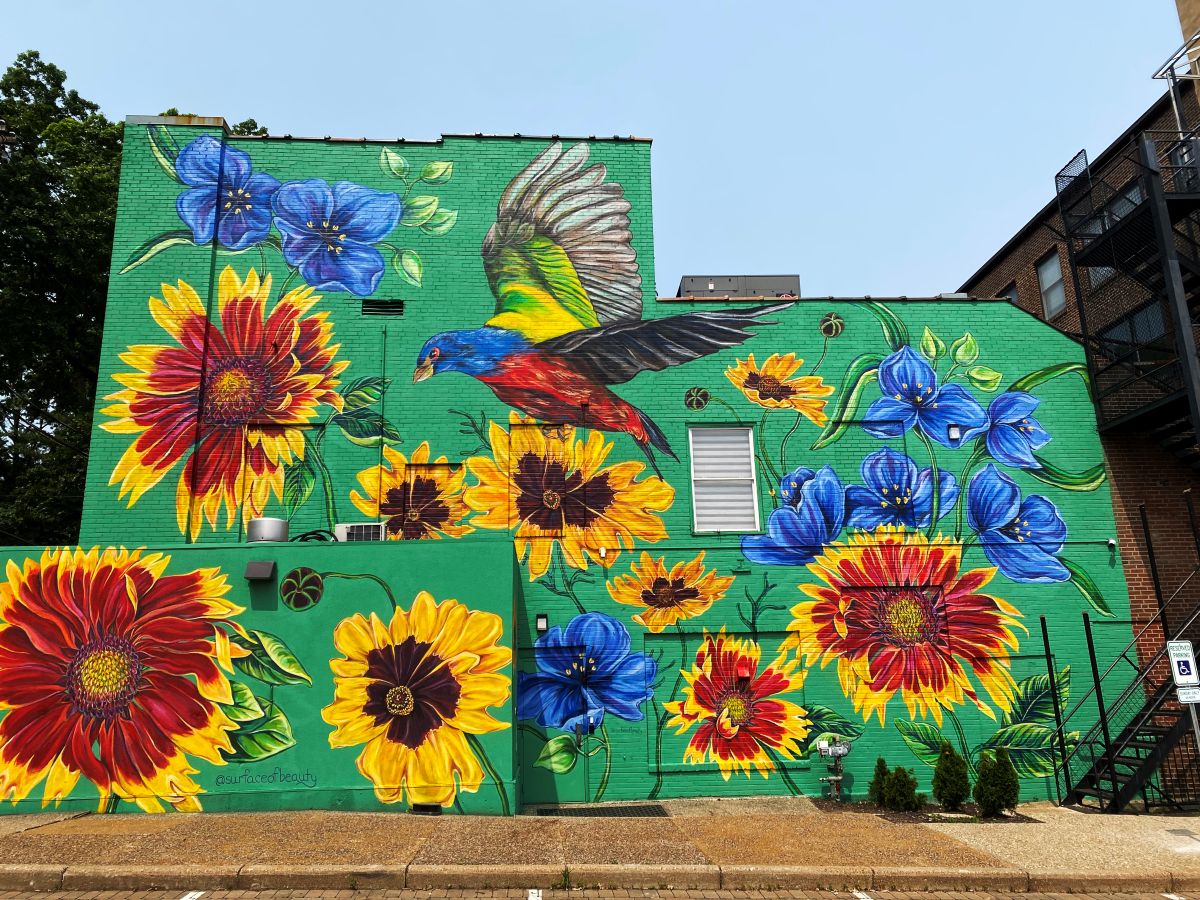
The mural project in St Louis was on the façade of a beautiful historic brick building called the Tivoli. It used to be a movie theater showing cult classics, and now it is a church that pulls its congregation from across St Louis.

I never saw a more diverse congregation and people so happy and proud of their church. It was a wonderful energy to be a part of, from the pastor and his beautiful family who lived around the corner from the church and came to check every day on my progress, to the parishioners who celebrated each emerging flower and color on the wall.

The mural was big though, wayyyy bigger than I could tell from the photos of the building I received before I got to St Louis. 

 Right next to the building was another mural by famed local artist Cbabi, celebrating Maya Angelou and her work “I Know Why the Caged Bird Sings.”

I had the idea that on my mural, I would feature a magnificent bird flying free among the native wildflowers of Missouri, to bring that hope and prayer into reality. That meant that I would have to draw a bird that was two stories tall from beak to wing-tip.

And of course, because I’m Surface of Beauty, I do everything freehand! Uh-oh.

Freehand Meets Its Challenge

It’s long been a point of pride for me that my murals are drawn entirely free-hand, and it is a sort of beautiful dance and communication between me and the wall. Most other mural artists use some sort of grid/projection/AI glasses to get the initial sketch up on the wall, but I love the first day exploration of feeling out the wall in its physicality and imperfections, adjusting the design to grow around the odd AC vent or exhaust pipe, and making my flowers really grow into the wall rather than just decorate it. 

I’ve felt that this freehand technique is my hidden secret, which makes my murals come alive, grow onto the wall, and really become a part of their environment.

But on this project, I realized that everything has a time and a place. I was woefully unprepared to draw a two-story bird. As I was trying to trace out the spread top wing, I couldn’t even SEE, let alone imagine, the part of the wall where the beak should be. It was one full story below me.

How could I get any sense of the scale or the proportions of the body? 

I was shaking and sweating, and almost crying. Nothing to do but just keep going up and down on the lift.

Down I went—oh no! The bird should be two times bigger at least! Back up—is the beak here? Back down—Oh no, it should be at least two yards to the left.

Well, that was the first part of the afternoon. I will say that when I nailed it, and yes, I finally did nail it, to where it just clicked into place and was absolutely perfect, it was a feeling like no other. I stood on the ground looking up at the bird, and I had no changes, no comments. I felt a harmony in my body and the wall as if we were one, and it was truly bliss. And I love those moments more than anything else in life.

But at what cost?

The next day I was tired, and I worked slower, and I had less internal energy to make miracles happen. I slogged through a blur of petals and was grumpy with my assistant. And that’s when I realized that it’s not fair to my animal body or to anyone else around me to live perpetually on that wing-it, make a miracle high.

This is my job, my work, and the kind, responsible thing to do is make a plan and follow it. Even if that means using a grid to get the design up (for really big murals only, of course).

For the next 7 days, between runs to Lowe’s to get the super durable house paint that I use for all my murals, I re-examined my entire mural process with my assistant. Her perspective was invaluable. Together we decided that those miracle moments, doing the impossible and having everything click into place after hours of sweating and panicking, are indeed what makes my work come alive and have its unique power.

But those moments can be optional, for when I have the energy, time, and internal resources to make them happen. I can include a few of those moments each mural, on a particularly wildly unfurling flower, or a beautiful swirl of tiny buds.

In short, they are a luxury. But it is unfair to myself to expect every single thing I paint to come from that space. I need to have an automated system that I can fall back on for most of the days, and that other people can more easily help me with. That will involve grids, more highly pigmented paints so I have less work to do with color layering and shading, and more initial planning and color mixing to make a more systemized approach to how I use the color contrasting I love so much in my work.

A Turning Point in My Career

I think this mural was one of the most important murals in my career, because it marked the gateway from an entirely new way of working. And I think the end result is going to be much better.

For example, in this mural, I painted all the leaves on the last day. I gave my life blood to the flowers, and by the time the moment for the leaves rolled around, I had nothing left to give. I really didn’t. 

So between you and me, the leaves are a poor shadow of what I was hoping for. I think in my new system, I won’t waste so much energy in the initial days, and I’ll be able to get through the whole mural more easily and then make moments of magic happen in the end when I have the luxury to do so. I think it will lead to a more cohesive mural, with moments of true excellence layered on top of a base that’s already good enough.

And my nervous system won’t have to work as hard to keep up with my roller-coaster ride of panic and bliss hormones. I’m very excited to see what the new me will create.

Experimenting with a New Mural Style in Miami for Art Basel: Taking Risks and Making Mistakes

It was a goal of mine to paint in Miami during Art Basel 2023, and just a week before Art Basel started, I hadn’t heard back from any of the projects I had applied to. Then my phone rang a few days before the festivities started, while I was on the beach in Mexico, and I knew I was going to be on the next flight to Miami.I didn’t have much time to prepare my design, but I had one of the strongest visions I’ve ever had for a mural. I saw a bright, tropical, and very bold, modern mural—all the qualities of Miami. So I decided I would try a color-blocking technique I had seen other muralists do, and which I had been wanting to try for a long time. I had a beautiful pair of walls as my mural canvas, and almost complete freedom when it came to design, so I decided this was the moment!

Color Blocking for the First Time

The look I envisioned for the mural was lines of bold bright color traversing the mural at geometric angles, and changing the color of any element they crossed along the way.  For example, if I had several yellow flowers in the mural, and a bright pink line crossed that part of the mural, the yellow of the flowers would change to orange (pink + yellow) within the confines of the line. 

Then if the pink line continued its path, hitting some green leaves next, the green of those leaves would change to purple (pink + green) within the line.

 If you are wondering how I got orange from pink + yellow, you are entering the slightly frantic headspace I was during the entire mural process.  Does pink + yellow make orange?  Or does it make a lighter pink?  Does pink + green make purple?  Or does it make brown, which would look horrible?  With my usual “more is more” style, I decided to pick bright color that I thought would look good in these intersections, and not worry too much about the laws of color theory.

The Chaos of Art Basel, Plus Having to Draw Straight Lines

So the plan was to paint two complete two-story buildings in six days. With all the Art Basel traffic, I averaged about 2 hours to get from the only available Airbnb left in Miami down to the mural location in Overtown, near Wynwood. I wasn’t able to fly my assistant down from NY, as flights were 20x more expensive than usual. And all the paint stores in Miami were running out of spray paint.

So there I was, auditioning mural assistants I had found the day before on Craiglist, while I was trying to figure out how to paint a color-blocked mural fast enough to cover an entire building in 3 days.  It’s surprising to say, but this was the very first mural I ever painted where the background color was not solid. 

Usually I pick a background color, and then paint my flowers on top (with all curvy, flowy lines of course!)  Now suddenly I had a white wall, where I wanted a complex interplay of different colors intersecting and interacting, and given my 3-day time constraint, it didn’t seem to make sense to spend a day painting a background color which was going to be altered by the color-blocking anyway. 

So I decided to start painting the flowers and the background at the same time, moving across the wall one area at a time. You can see my first day’s work in this slightly chaotic but promising little area done on the bottom left.

Problem one:   I forgot that this entire idea requires straight lines!  Anyone who knows my work knows that I always work free-hand, with no projection, measurement, or grid of any kind.  Well, I tried to do the same for this mural, which definitely needed more geometrically precise line-work than my usual curvy florals. 

You can see my imperfectly sketched lines in the work-in-progress pictures—no ruler or tape to be seen! To be clear, I am very happy and proud of how the mural turned out. It’s one of my favorites. But at some point in the process, I just decided to lean in to the “artisanal hand-crafted” nature of my work, and stopped even trying for straight lines. They are all a bit wonky, and I think that’s what makes the mural pulse with life. I’m just not an artist that does things in a measured and accurate way, and I don’t think I ever will be (or want to be).

Paint Troubles, and Mixing my Own in a Time of Crisis

Problem two:  I had absolutely no idea what colors I would use, how much of each color I would need, and all of Miami was running out of paint!  My poor Craigslist-chosen assistant started each morning at the Home Depot buying new sample sizes of different colors I had selected the night before from the online Behr colorcard (an invaluable resource!). 

I designed the mural as I went, and while I was painting the left side, I didn’t know what colors I would be using on the right side. It was such a complicated composition that I needed to see one side come to life in full-scale before I could decide what colors were needed to balance the other side.

On the last half of the last wall, all the spray paint stores in Miami were out of the Montana green I needed to finish my green line. I finished that whole side of the mural with a darker green, dusted with fluorescent yellow that I found, and somehow the yellow spray dust made the green look the same as the missing color—at least from a distance. That is the beauty of murals–we must always, always look at the big picture!

Painting murals has certainly helped me get over my perfectionism, and this mural more than any other. It was supposed to be my most precise, straight, measured mural, but it was the most chaotic and unplanned mural I have ever painted!

Cheers and Support and a Pair of Painted Jeans

The residents of the building were cheering me on every time they came out, and as Overtown has a large population of people experiencing homelessness, there was always a crowd watching my progress from across the street. 

By the time I started the second wall, everyone was won over.  People were cheering support as I drew the first rough outlines of the flower on the second wall.  One man shouted, “that’s the best petal you’ve ever drawn,” when I had only drawn a few messy marks to block in the outlines. 

It was such a warm and hospitable atmosphere, and it felt like people were really happy to see my art.  At the end of the mural, I finished my last cans of spray paint on one of the men’s jeans.  He asked me to just spray whatever colors I had left on his jeans so he could remember the process of making the mural.  It was an honor, as was the entire experience and the warm welcome of the community. 

The Unexpectedly Transformational Experience of Painting a Mural in Austin, Texas

Destination: Austin

For about a year, I had the strong intention that I wanted to paint a mural in Austin, Texas. I asked my SEO team to work on positioning me higher in the search results for “flower mural Austin.” I wrote in my journal about once a week with the intention to paint in Texas, a state where I didn’t have any murals yet. About a month in, I got a surprise cold email inviting me to paint in Waxahachie, Texas, a small community outside of Dallas. I accepted and went to paint, but I still longed to paint in Austin, for reasons that weren’t quite clear to my conscious mind. 

About eight months later, I got a surprise email from a boutique hotel in Austin! The woman wrote in an excited and slightly apologetic manner. She mentioned that she had been searching for a floral mural artist near Austin and had come upon my website. Then she realized that I was not based in Austin! She said she loved my work and was there any chance I would be interested in traveling to Austin. Of course my answer was an immediate and emphatic yes! And, by the way, SEO works!

A Magical Hotel Full of Wall Art

When I arrived in Austin late at night and checked into my room at The Frances Modern Inn, the hotel where I was to be painting my wall art, I felt like I was at home. The aesthetic was exactly mine—there were murals by different artists on each floor. My room was decorated with unique, hand-picked antiques from around the world, combined with lush floral wallpaper in jewel tones and luxurious carpeting and bedding. Floor-to-ceiling deep turquoise velvet drapes shut out the world outside. 

The bathtub had fresh flowers on a wooden board across the tub. I immediately bought some Epsom Salt from the convenience store and settled in for a luxurious soak. In the days to come, over long exquisite Italian dinners with the inn owner and some staff members, I got to learn about their lives and build intimate relationships that truly touched me and inspired me. We shared deeply meaningful personal stories and I learned about the vivid inspiration behind the creation of the hotel.

Painting my mural was a chance to do my absolute best work. The wall was small, so I had the comfort and ease of painting each line with intention and even re-painting certain elements several days—which requires a luxury of time that I rarely have in my larger murals. I felt supported and nourished by the guests, the delicious food, the staff, and my gorgeous room. It was truly a treat. However, looking back on the experience almost a year later, I see that my trip to Austin changed the course of my life in an unexpected and profound way.

Unexpected Healing through my Mural Art Destination

I had been recommended by someone in New York to visit a very special healer while I was in Austin. He wrote an introductory email and set me up with an appointment. This healer uses the Network Spinal method, which is a very subtle spine adjustment technique designed to liberate the nervous system from emotional weight that has been stored up over a lifetime. My reason for seeking care was directly related to my mural career. Over the course of eight years painting floral murals, I developed a constant pain in my right hip from twisting on a ladder and using my right hand to paint. I highly recommend to other mural artists that they always directly face the wall on a scaffold, rather than twisting on an A-frame ladder. I, however, learned the hard way.

My first appointment was nice, but not remarkable. In my second appointment, a few days later, the healer passed her hands over my spine, and I felt a burst of energy rush up from my right hip to the top of my head with an incredible speed, almost like a champagne bottle bursting open. I felt light-headed from the force of the sensation, even though I was lying down. After the session, she asked me a few questions about my hip pain, when it had started, etc, and I suddenly started crying. I knew in all levels of my body-mind being that the hip pain had started on a particular floral mural years ago where the client had triggered some unresolved trauma from earlier in my life, by repeating certain behavior patterns and abusive ways of treating others.

After the appointment and in my last few days in Austin, I began to feel incredibly and almost indescribably sad. It was as if all the stored and unprocessed memories from long ago had been released out of my hip and into my nervous system at large, and my body now had no choice but to process them. I felt overwhelmed and almost overpowered by the force of these now re-surfaced emotions. There was no way but through, so I had to surrender and let myself feel all of the sadness and fear that was flooding my system. I now realize that my trip to Austin was even more significant than creating a new flower mural.

A New Mural and a New Inner Peace

I returned home and about two weeks later, the feelings reached a peak. I felt almost drunk with the intensity of whatever was happening in my system. Almost like my body was fighting a virus, I felt like every cell of my being was consumed with dealing with whatever had been released in the upwards rush of energy I experienced in that healing session. In that particular 24 hour period, I felt like I wasn’t in control of my thoughts or emotions at all– that my body was purging in its own way just as the body vomits uncontrollably to cleanse itself of an invader. 

I have never had such an experience before or after in my life. After about 24 hours of riding this wave that was bigger than my conscious mind, I felt it subside. I called someone from my past and told them my truth for the very first time in my life. I finally had the words, the clarity, and the calmness to express what my experience had been. It was surprisingly well received. It has now been almost a year since that event, and I have a lightness inside my heart that I carry with me every day. I struggled with low-grade depression for most of my life, but the astonishing truth is that those particular feelings of despair and lethargy unique to depression never come anymore. I live in a completely different inner world.

The calling I felt so strongly to paint a mural in Austin led me to a series of tangential events that truly changed my life. How everything happened feels mysterious and unknowable, but there was an undeniable and marked shift in my life since my trip to Austin. And I know that my mural will light up the hearts of others who visit that incredible hotel in the heart of downtown Austin.

Painting the Largest Flower Mural of My Life: 3500 sq feet in Charlotte, NC

As an artist and a business owner, I am constantly refining the type of projects I want to take on, as I have realized over the past seven years of painting floral murals across the US that my definition of success is being able to choose where to put my energy. My current intention is to paint large scale murals a few times a year, where I can really expand my techniques and have a bigger impact on the surrounding community with my art. I also want to concentrate my energies on the southern United States, including Texas, Alabama, Florida, and Georgia. So I was elated when I was selected to paint the largest mural of my life in Charlotte, North Carolina—a project aligned with both of my latest goals.

Designing a Minimalist Mural for the First Time 

One of the things I love about mural painting is that the inherent limitations of time and weather conditions force me to think in new ways and constantly imagine more effective ways of creating beauty as a painter. Mural painting helped me get over my perfectionism, and always keep progressing to reach a finished piece in a short amount of time. It’s an exciting and motivating journey to be on as an artist.

For this mural especially, I had to change my normal painting technique and my normal design technique to be able to cover so much square footage in 10 days of work. I am in love with the results and the finished mural, and now I have new-found confidence that I can paint even larger murals—perhaps a 10-story building in Austin, Texas, for example!

For the design of this mural, I chose to focus on large floral elements, and a more minimalist composition with lots of negative space balancing the flowers. The final result was cleaner and more graphic than my normal work, which usually is filled evenly throughout with vines and tiny wildflowers.

Modifying My Painting Techniques for a 30-Foot Flower

As for the painting technique, because my design included two large flowers that encompassed the total height of the wall, and the surface of the wall was very irregular and rough with uneven concrete blocks, I realized my normal painting style of brush would be too time consuming. To use spray at that size would also consume an enormous amount of spray cans and I would be forced to spray for the entirety of the day. Because I am sensitive to the chemicals in spray, even while wearing a mask, I can only spray for a few hours a day if I want to avoid side-effects like headaches and nausea. 

 After a lot of thought and discussion with other muralists, I decided to use rollers and house paint to get a base of color on the wall. I mixed three different paint colors freely while my assistant and I rolled, so that the flower would already have a natural texture and irregularity in color that gives it depth.

The first layer done with rollers had a lot of gaps and holes where the base color showed through, because the rollers can’t get in to the irregular crevices, but the next layer in my process solved that problem easily! The next layer we did was spray, covering the unfilled areas of base color, and also creating a linear directionality to the petals. We used around ten different colors of spray for each of the flowers to add depth and shading to the petals. The spray was a mist over the existing base color that we had rolled with house paint, so there was a lot of richness and texture to all the different colors interacting in different layers in differing levels of opacity.

The final step or layer in my new process was detailing with brush in about twenty colors of house paint in the sample size. I buy samples so I can have small quantities of many different colors to play with for the detailing. In this third layer, I defined edges, created the delicate puckering effect of wrinkled flower petals, and added details like folds and irregularities. The flower came to life quickly, especially with the rich background canvas I had created with some many colors interacting. I spent far less time than I had expected in detailing, as just a few details concentrated on the petal edges really served to bring the whole flower to life.

The Experience of Painting in the South

I am truly enjoying painting murals in the South, as compared to my normal workplace of New York City! I have recently painted in Nashville, Tennessee; Dallas, Texas; Birmingham, Alabama; and now Charlotte, North Carolina. In all of these locations, I’ve enjoyed the sunny weather and inspiring foliage, the calm atmosphere, the short commutes, and just an overall simpler and calmer lifestyle.

For this mural, I was painting right in downtown Charlotte, and I was fortunate enough to find an affordable airbnb just 10 minutes walking away, with grocery stores and everything I needed right around me. Compared to my typical hour plus commutes in New York City (just for one leg of the journey, so totally two or three hours total a day!), this lovely 10 minute morning walk from home to mural location was an absolute joy. I noticed that I had more energy, less stress, a much more positive attitude, and I could truly enjoy the painting experience.

It’s amazing how commutes can drain us and expose us to so much energetic clutter when we are crammed for hours in a small space with stressed-out strangers. I love the fresh air and historic old trees in the South, and of course the relaxed and friendly people.

A Big Step for More to Come

I’m so happy that I was able to share my work with the community of Charlotte, North Carolina, especially because I believe it’s one of the largest murals in the city. My efforts were well spent as I completed the mural on time, and I didn’t lose energy unnecessarily on the stress and clutter I find working in Northeastern cities. I think this mural is one of the cleanest and most effective designs I’ve done, and I’m happy with the simplicity and balance of space and color. Here’s to more large-scale murals in the South in the months to come!

A Complete Shutdown: My Journey with Sensory Burnout

This past December, I found myself having difficulty speaking, and exhaustion so extreme that I found a simple trip to the grocery store to buy vegetables overwhelming. I had trouble replying to text messages, and I was not able to read, watch videos, or listen to podcasts because I couldn’t process new information. Daily noises like passing cars and the hum of the refrigerator deeply disturbed me, sometimes to the point of tears. Many days I sat and stared outside the window at my garden for hours, sipping tea, and wondering if I would ever be a normal person again. I had very few thoughts and slept for more than twelve hours each day. I felt like a stranger to myself and I worried that very few people would understand what I was experiencing, especially because I didn’t understand it myself.

Sensory Burnout is Not Depression

Oversleeping, no enthusiasm for normal activities and interests, crying often, not seeing friends—these are often the symptoms of depression, and these are the symptoms I was experiencing. However, the normal strategies to heal depression actually can make sensory burnout worse, so it is important to raise awareness of the differences between these two conditions. I am deeply grateful to my own therapist and several of my friends who are trained therapists for helping me to recognize what was actually happening to me, and giving me the appropriate strategies to begin to heal.

I was experiencing sensory burnout, a state where the nervous system is so overwhelmed that it begins to shut down. People with neurodivergent brains are very susceptible to experiencing sensory burnout, because the way their brains process sensory input is different than how neurotypical brains process sensory stimuli. Bright lights, loud sounds, crowded places, and neurotypical socializing in groups (think small-talk) can be exhausting physically and mentally, and overexposure can culminate in a complete overwhelm and shutdown of the nervous system.

It’s very important that we as a society spread awareness of the difference between sensory burnout and depression. If someone is suffering from depression, it’s helpful for them to go out, see friends, try a new activity, and engage in other active pursuits.

However, for someone suffering from sensory burnout, doing these things can exacerbate the condition even more. It is extremely important to sleep, rest for long periods, not socialize in crowded places, and engage in soothing interests, often alone. I am so grateful that I was given the appropriate advice by my therapist, and did not feel pressured to do any activities or socialize. I recovered by sleeping, staring out the window, crying, and being alone for almost 6 weeks. Crying is way for the nervous system to release stress and overwhelm and re-regulate, just like sweating is a way for the body to regulate its temperature. I truly think allowing myself to cry as much as my body needed was the fastest way to heal.

Releasing Shame

I want to share my experience because I know that many of us highly-sensitive and highly creative people are pushing ourselves in ways that we are perhaps not even aware of. In order to fit into the expectations of our modern culture, we do too much, expose ourselves to too many bright lights, loud noises, and crowded spaces, and we don’t know how to relax. Relaxing is not watching more screens, receiving more input and stimuli that our nervous system again has to process. Relaxing is being with nature, silence, and letting our thoughts unwind and release without adding more input/entertainment/distraction.

When we have pushed ourselves beyond our limits, the body and the mind freeze. We can’t process more, we can’t do more, we have no interest in external things or people because we simply don’t have the emotional and cognitive space to interact. I was very confused and scared when I found myself in this situation, and I know there must be many other people experiencing a similar state of being. When well-meaning friends tell us “go out and do something fun,” or “get out of bed and meet a friend,” feelings of shame get layered on top of the already confusing and numb feelings of exhaustion. We think, “What’s wrong with me,” or “I’ll never heal because for some reason I just can’t take any of the right actions to heal.” But in fact, this advice is coming from a lack of knowledge, and it shames us unnecessarily because it is not meeting our needs—in fact, it is pushing us away from our ability to meet our own needs. In this type of burnout, the cure is rest, sleep, aloneness, silence. Many people are not aware of this, and in fact they become fearful when someone they love is exhibiting what they perceive as frightening and concerning behaviors.

Pushing someone in sensory burnout to do more actions is slowing down their healing and adding a layer of shame and confusion to their healing process. It would be like if you had a broken arm and you were unaware it was broken, but you were experiencing pain and stiffness. You explain your suffering to a friend and the friend, also unaware of your condition, advises you and encourages you to practice yoga to relieve the pain and stiffness of your arm. But your arm gets worse and worse each day, because yoga is not the cure for a broken arm—and you feel shame and confusion, thinking “What is wrong with me? Why am I not getting better? Yoga works for everyone else, but just not me.” If you knew what was wrong with your arm, you would be able to find the treatment you need, and explain to others that their best guesses are actually the opposite of what is needed in this specific situation. But if you don’t know what is wrong with your arm, you will feel shame, confusion, alienation because nothing is working and your symptoms are getting worse day by day. Similarly, sensory burnout needs to be treated with the right practices for its specific condition and there is nothing wrong with you if you need to sleep and rest from a lifetime of overstimulation. Allow your body and nervous system to do what it needs to do in order to heal.

Healing Takes its Own Time

I’m writing this in Mexico City, where I am enjoying a slower pace of life, observing the sunlight and shadows of the lush flora and fauna in my neighborhood, and cooking meals at home. I have started working on two new murals and have been enjoying the process of creating once again. It’s surprising to me how quickly my body settled into a new harmony of being and doing, after my period of solitude and exhaustion, but I am aware I am still recovering. The years of hustle-culture and overexertion of my capacity has taken a toll which I have not fully felt and probably not begun to process. The progress is that my nervous system is no longer sounding a full-body alarm.

I hope for myself and others who have experienced similar states of burnout that I will tend and care for my nervous system on a daily basis in more well-informed manner. I am becoming conscious of my daily limits. I am becoming conscious of what overwhelms and taxes my sensory processing abilities, and what nurtures and rejuvenates me. I am noticing that even though I truly enjoy and flourish in crowded environments with lots of stimulation, I need to also provide myself with a longer period of silence and rejuvenation afterwards. I am learning that relaxing and replenishing for my specific nervous system cannot involve socializing or screens. Even though I love adventure and travel and interacting with new people, I have to conscientiously count those actions towards my daily quota of activity and carve out time daily to rest and let my nervous system do nothing.

It is humbling and it is also beautiful to see the limitations of my body and respect them with intention and care. I feel like this experience has helped me take a kinder and softer perspective towards myself and others, and I hope that sharing my experience can provide something of value to someone else.